Collective decision making - consent vs. consensus
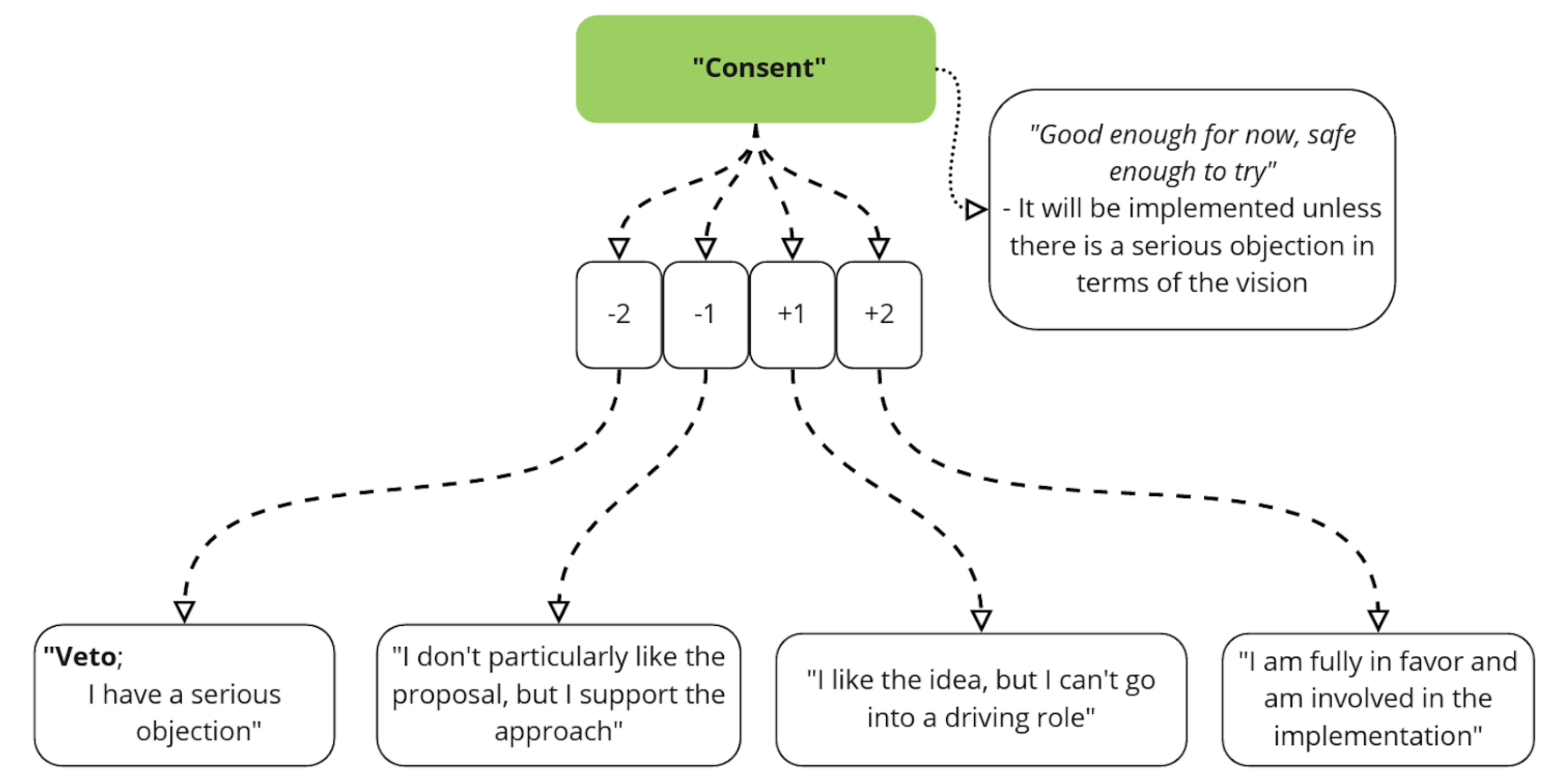
Someone makes a suggestion. This suggestion is briefly discussed and if no one has any objections, the suggestion can be implemented according to the principle "good enough for now, so safe enough to try."
Why it's worth it:
In groups with varying levels of participation, majority voting can slow down processes - especially if decisions are only made once everyone has voted. Consent, on the other hand, makes it possible to implement proposals as long as no one has a valid objection. This encourages initiative, keeps groups agile, and creates space for trial and error without waiting for perfection or complete agreement. In this way, impulses can be taken up and ideas can be developed further even if not everyone is present at the same time.
What do we need
- Online or in person -30-60 min
- Three or more people
Procedure
1. Clarify roles: At the beginning, a moderator is appointed to guide the process. Optionally, a second person can take notes to record proposals and decisions.
2. Present the proposal: The person making the proposal presents it clearly and as concisely as possible. The proposal is documented in such a way that it is clearly visible to everyone - for example on a flipchart, whiteboard, or digitally in the chat or on the screen.
3. Clarification round: In this round, everyone can ask questions for further understanding. This is exclusively about clarifying ambiguities, not about evaluations, opinions or discussions of content.
4. Reaction round: Now each person has the opportunity to share their spontaneous reaction to the proposal. These can be thoughts on strengths, risks, open points, or ideas for improvement. There is no discussion - everyone listens attentively to each other.
5. Consent enquiry with approval scale: All participants give their opinion on a scale from -2 to +2:
-2 means "Veto: I have a serious objection. The proposal must not be implemented because..."-1 means "I have reservations. I am not convinced or see shortcomings, but I can live with the proposal."+1 means "I think it is good. I support the proposal, but do not want to take a leading role in its implementation."+2 means "I am fully in favour. I am convinced by the proposal and am actively involved in its implementation."
A proposal is deemed accepted if nobody votes -2.
6. Dealing with objections: If there are objections (i.e. at least one person chooses -2), the group chooses a suitable method to deal with them.
Possible ways are:
- The moderator adjusts the proposal directly.
- A quick round of feedback is made with the question: "How would you solve this?"
- A short conversation is facilitated in a small circle (e.g. with 2-3 people).
- An open dialogue is facilitated with subsequent updates of the proposal.
- The proposal can be revised or passed on to another circle or group.
The decision-making process then begins again, ideally from step 3 or 4, until there are no more serious objections.
7. Announce the decision: If everyone has voted at least -1, the proposal is considered accepted. Whether the proposal can or should be implemented may also depend on how many can or want to actively participate in the proposal and have voted +2. The decision can be briefly named and honoured to mark the transition to implementation.