Laoshi village, the site of the project, is located in the western region of Hainan Island, the southernmost province of China. It sits near a harbour where seawater meets freshwater flowing down from the central mountains. This mingling of salt and fresh water sustains a rich local biodiversity, while also making possible the traditional livelihood of sea salt production, both historically and in the present.
To push the boundary of knowledge and challenge the knowledge politics behind environmental governance, we proposed three key questions to understand and engage with the village’s bio-cultural history and its present as a living entanglement of the biosphere, local traditions, foodways, beliefs, and the interactions between human and non-human entities:
1. How do residents culturally and socially shape the relationships between ecological systems and community life in their everyday practices?
2. What collaborative actions can we take—through art, science, storytelling, and governance—that nurture, restore, or reimagine the connections between local ecologies and culture?
3. How does learning from a specific local knowledge system and its practices inform our understanding of knowledge production and governance in a broader context?
Like the growth of a tamarind tree, the first question serves as the root, firmly grasping the local context and allowing us to thoroughly study the local system. The second question represents the trunk, linking the roots to the branches and facilitating exchanges between the local environment and the outside world. The third question embodies the branches and foliage, illustrating how our project extends to a wider context, responding to governance crisis beyond our village.
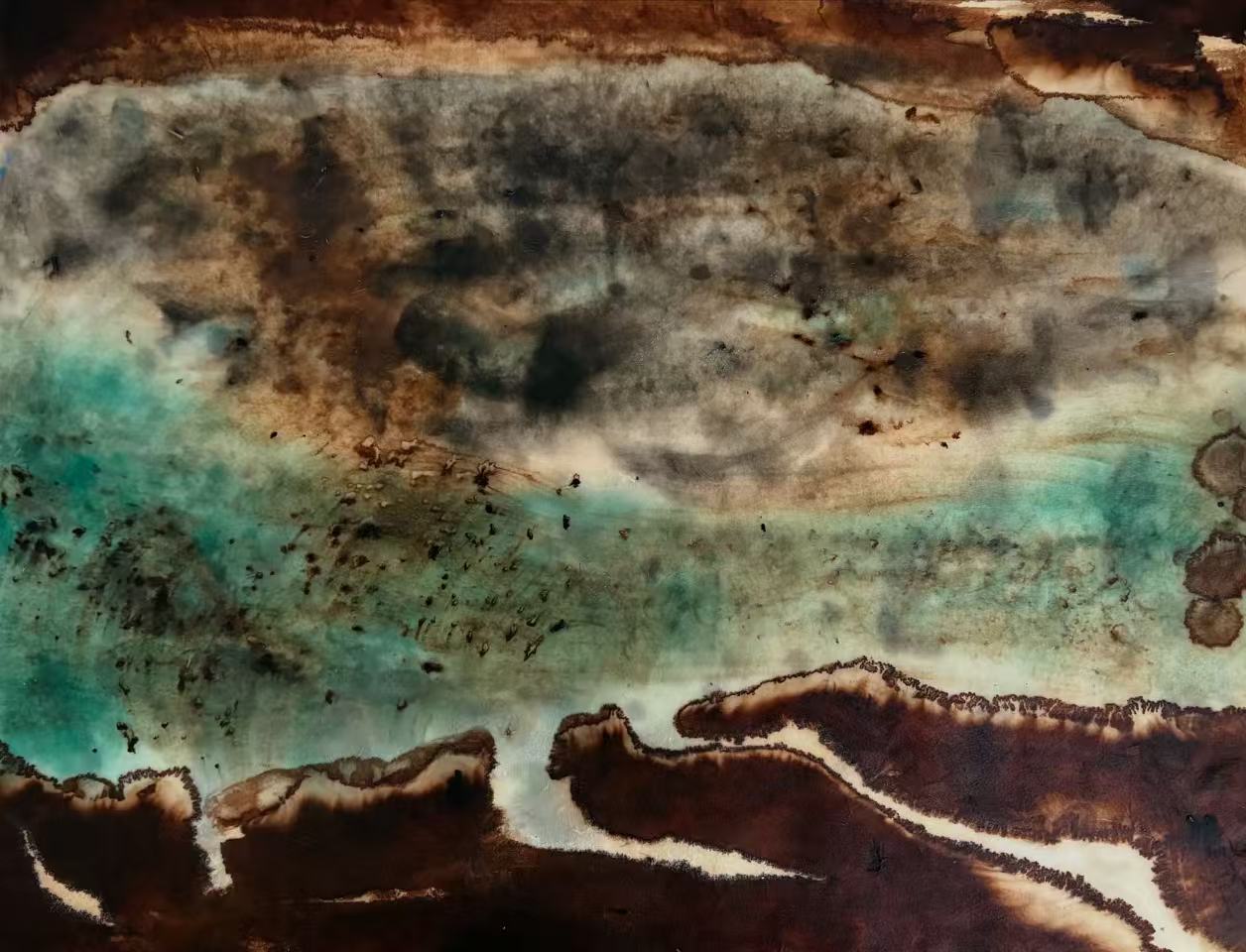
Chengwei Xia | Estuary
walnut ink, Chinese ink, and watercolor on Nepalese mountain paper 2025
In the local language of the rural community where our project is based, "Mou Gan" means the roots and trunk of a tree. The community is surrounded by a forest of tamarind trees planted by ancestors. These trees play a vital ecological role in preventing soil erosion along a local estuary that brings seawater to the village's salt farm which is essential to local livelihoods. By naming our project “Mou Gan,” we honour the ecological significance of these trees while expressing our wish for the project to be deeply rooted in local soil, nurtured by the community, and to provide shade and resources for the village while also extending our reach to a broader context.
Our collective invites villagers and the public to explore the ecological and cultural life surrounding the major ecosystems of the village. Developed as a platform for co-learning bio-cultural connections, we aim to challenge top-down models of environmental governance that prioritize technocracy. We aim to center traditional knowledge, embodied experiences, and emotional connections as valid forms of environmental understanding. We follow three main trajectories: learning from local knowledge systems through embodied experiences, fostering collaborative practices via art, science, storytelling, and governance, and connecting this learning to broader environmental discourses.
We will use participatory, interactive, and embodied approaches in two main activities: transect walks and salt-making. Transect walks along the local river will bring together residents, officials, planners, collective members, and others to move through and reflect on community spaces. We will hold mapping workshops to co-create participatory maps of ecological change, memory, and daily life. These maps will be shared both in the village and on our digital platform, forming a living archive. We will also launch a Seasalt Farm School, where participants will learn salt-making from local salt farmers and the environment itself—reading tides, sunlight, and weather. This labor fosters intimate, bodily relationships with place and reframes knowledge as something lived, sensed, and shared.
These activities support eco-centered, embodied knowledge as an essential part of environmental governance. They also offer spaces for local people to collectively revisit bio-cultural memory and activate their stewardship with nature and place.
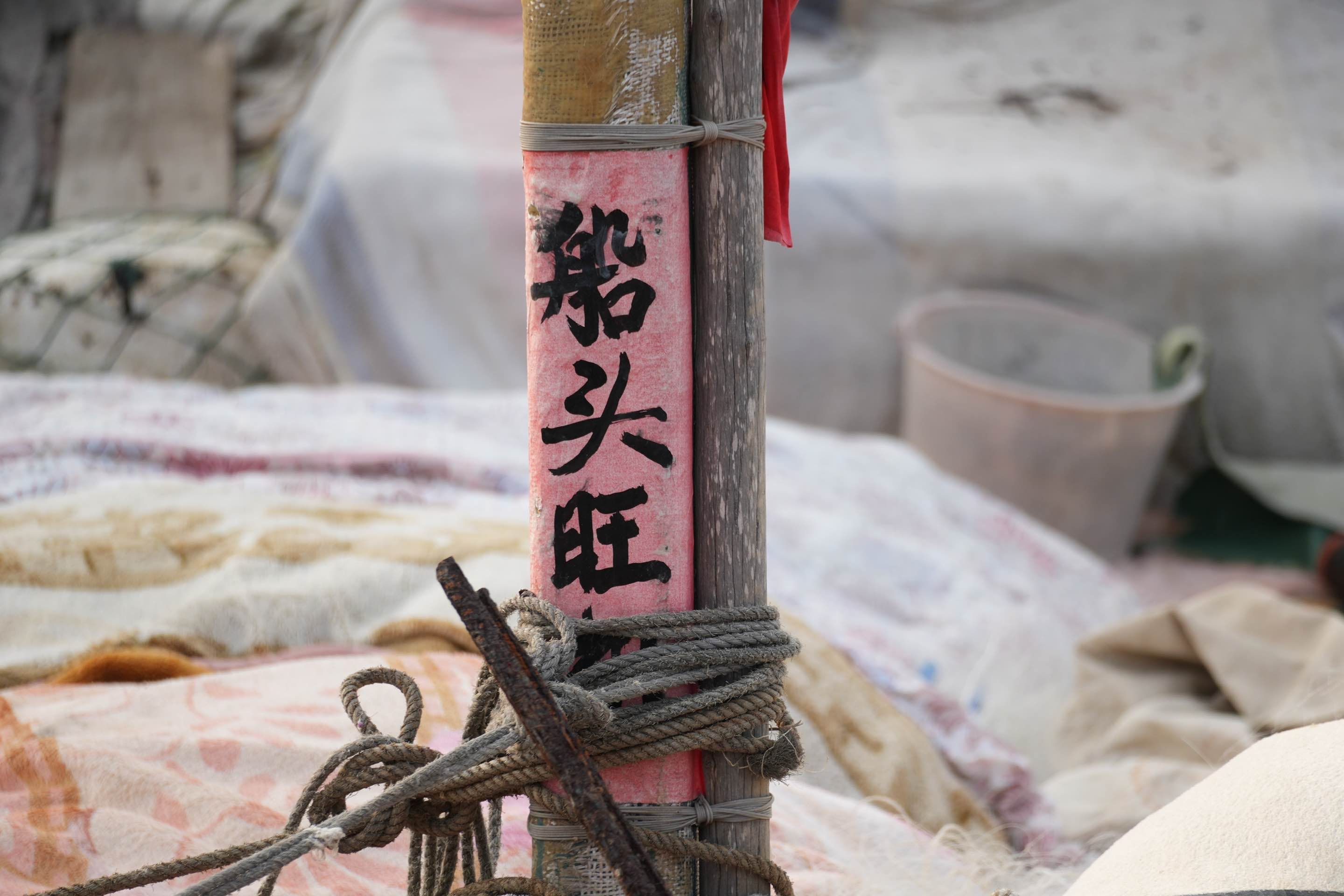
Shuhao Lin | May prosperity to the boat @ Haitou
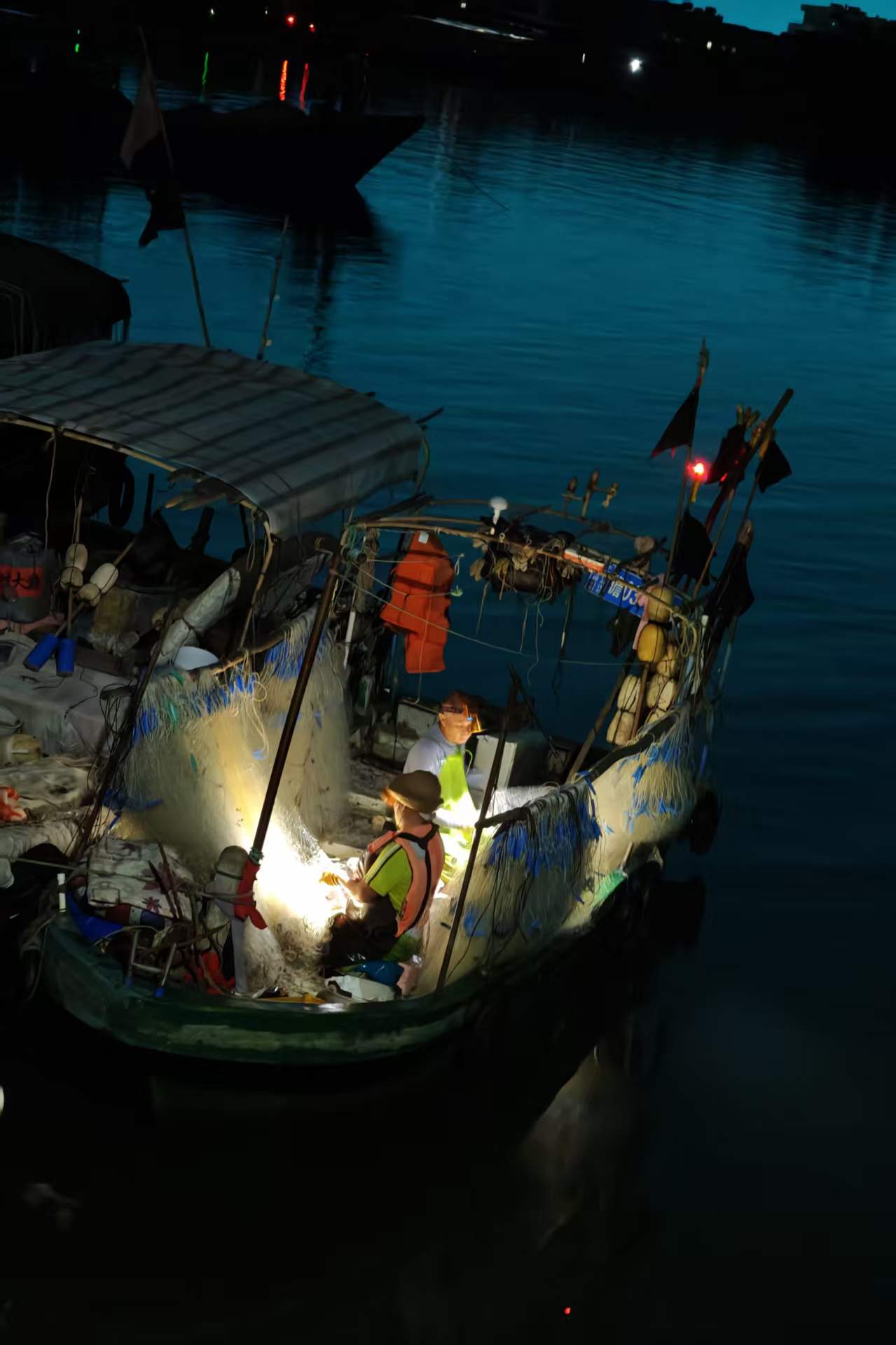
Gu Qiu | Light on a fish boat
Chengwei Xia
Chengwei is an artist from Sichuan, China, currently based in London. Her practice moves across drawing, writing, and making, approaching art as a slow, relational process of co-presence, care, and cultivation. Her work unfolds through long-term attention to specific places and relationships.
Huiqiao Qiu
Huiqiao (丘慧巧) is a social science researcher in Development Planning, examining how local practices and relationality could inform solutions toward socio-environmental challenges.
Shuhao Lin
An advisor to the Haikou Duotan Wetland Research Institute; a member of the IUCN Horseshoe Crab Specialist Group; designer and editor of popular science books; freshwater fish surveys.
Songzi Wang
Songzi (王松子) is an independent writer who explores the relationship between people and nature in local communities, she uses interviews and writing to uncover local experiences and ecological knowledge.
Xiyun Tan
The former chief of Laoshi Village. With over 10 years of experience in architectural design and project management and 8 years of experience in community govermance and sustainable development. I'm thrilled to join SoC to explore how 'commoning' can reshape rural spaces and facilitate local residents.
Gu Qiu
A content creator whose primary mediums are photography and poetry.
About our collective: Our transdisciplinary team includes a community leader, artists, a social science researcher, an ethnographic writer and an environmental expert. Together, we approach bio-cultural practice through multiple lenses and foster dialogue among communities navigating ecosystem degradation, the erosion of cultural memory, and governance challenges—especially the marginalization of local knowledge in environmental governance.
Logbook
04/2026
Mou Gan Project emerges from the long-term cultivation of eco-cultural relations within the local community of Laoshi, in Danzhou, Hainan. The project centers situated and embodied knowledge, activated through local narratives, relational mapping, and forms of labor, alongside ongoing reflective dialogue. It seeks to recognize and foreground marginalized local knowledge within contemporary environmental governance.
The project brings together community residents, scientists, social scientists/ethnographers, and artists. It also operates as a space of encounter between local culture, ecosystems, and diverse knowledge systems.
In April 2026, collective members Songzi, Shuhao, and Gu Qiu traveled to Laoshi to prepare for the upcoming Mapping and Sea Salt Farm School workshops in June. They engaged with local eco-cultural relations through transdisciplinary approaches, including river-centered walking practices attentive to encounters between human and more-than-human actors, photography, sea salt making, and the gathering of local narratives.
SoC Gathering, 2026
02.07.2026 — 05.07.2026
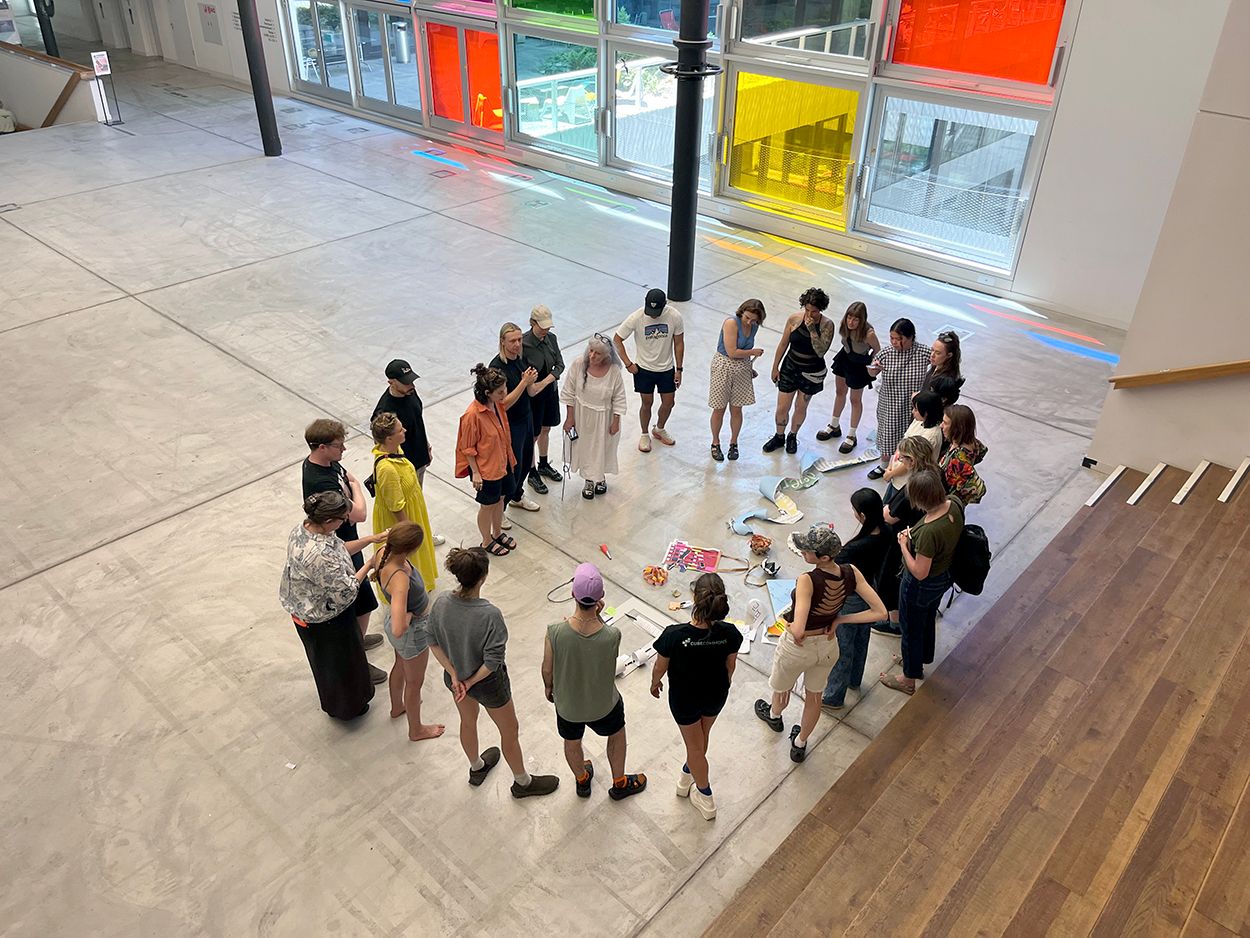
From gatherings in Geneva and Zurich to new collaborations, public programmes, and opportunities to connect — thank you to each and every one of you for continuing to shape School of Commons with your curiosity, generosity, and care. Find out more