CHIMERA: A Somatic Practice of Multiplicity

Collaborations as Chimera: Creative Duo

As friends and collaborators, our journey that leads to this practice has always been rooted in a shared Earth sensibility. Coming from different disciplines (and many dialectic oxbows), our combined body of knowledge and training spans sound art and music, neuroaesthetics and psychology, sustainability, fashion design,1 visual arts, writing, performance, and teaching. We funnel this odd multitool skillset in immersive artistic research that attempts to make sense of our place on this planet – developing and sharing practices to situate ourselves in ecology. We’ve embarked on projects that put our bodies skin-to-skin with the natural environment, scraped our knees, and plunged our hands into quicksand. We work with dancers to discover how movement might be a form of listening. We develop DIY meditations to tune into the Other – using each other as lab rats as we explore kinship with unexplainable phenomena. This all may sound very grand and poetic – but a core lesson we return to with every caper is that it is indisputably profound to go play outside.

As our work deepens and matures, and (bless) finds more fodder in humor and absurdity, we come to a state of easy access to our somatic landscapes. Through years of self-guided practice, we are both honed at attuning to our bodies, to our companions, to our environment. And so, sharing these exercises we've developed for practicing chimerical embodiment, we invite you into our world where we blur the lines of folklore and science. We invite you to become your own study of cryptozoology, to be generously playful in your speculations, to practice monstering with your friends and more-than-human neighbors. Learning to embody the Other is a method of ecological behavior.

A Legacy of Monsters

The Chimera is one of the great monsters of Greek mythology: a fire-breathing beast with the mixed anatomy of lion, goat, and snake. She (yes, female, according to the stories) was divine, descended from the great non-human gods who inhabited the world alongside the Titans. The legend, as told in Homer’s Iliad2, states that the hero Bellapheron, mounted on Pegasus, is ordered by the king of Lycia to slay the Chimera, who has been feeding off local cattle. Her death brought glory to Bellapheron, and Lycia was rid of a predator.

As Le Guin would put it, this, like many popular Greek myths, is a Killer Story: it is about the spear thrust, and death is its climax3. If we reposition the Chimera as protagonist (not hero, but main character), what would an alternative ‘Life Story’ be? We have a shining mascot of pluralism, subjected to a colonizing king’s attempt to tame the wilderness into which his cows wandered. We have yet another story of a non-conforming creature punished for existing.
To become a chimera not only acknowledges the pluralities and complexities we contain, it challenges us to change contemporary narratives on queer monstrosity. In our lifetime, sex and gender-based identity politics have arced from a mass culture of homo- and transphobia, to slow acceptance: the legalization of gay marriage, the incredible milestone of the third gender marker “X” on American passports, and unprecedented strides of trans visibility in media and politics. Until… 2025. The sudden pendulum swing back to hyper-conservative governance across global northern nations has flipped so much recent progress into a regressive nightmare, with queer and trans people once again on the chopping block – illustrated succinctly by the Trump administration labelling trans people as “terrorists4.” After the past decades of fighting to be protagonists, we are now, in the eyes of many in power, more monstrous than ever.

So, we crawl back to the protective mountains of Lycia, back into the mouths of our caves to lick our wounds and think: what next? We remember that monstering is generative – that learning to chimerize, to walk through the world carrying inner multitudes, also teaches us to be part of larger chimeras. We learn, from within our own bodies, how cooperative systems might mobilize. ‘Queering’ is, perhaps, not only for LGBTQIA2+ people; liberation from a learned identity doesn’t always result in a change of pronouns, gayness, or hormone therapy. Similarly, ‘monstering’ is a lesson learned through queerness, but may also be learned by anyone. We all contain worlds. And, we are all organs in the body of the World.

Relating Through Multiplicity

We draw inspiration from the Chimera’s ability to be ‘more than.’ More than one self, more than one creature, more than human. Our embodied knowledge of multiplicity is a chimerical experience, moving through daily life as a coordinated system of parts, personalities, feelings. But what might be learned from a deepened concentration on these chimerical qualities? Through our somatic research on chimerizing, we propose exercises – which may be practiced by anyone – to tune into our cooperative parts. By feeling with different identifiable inner elements, we attempt to more intimately know what sub-bodies hide within us. We move with these parts, letting each take a turn in guiding the whole. And we may zoom out one degree to become one part in a cooperative system with other bodies – both human and non-human.

The Chimera, our mascot monster, is a trio of beasts: snake, goat, lion. Even though we are a creative duo, the three-body body (or, more queerly, body-ody-ody) is an arrangement we intentionally retain. While, obviously, our inherent multiplicities contain countless facets, focusing on a select system of three allows for dynamism, for drama and for contrast. It trines the binary. It beckons us with the “secret third thing5.” Our working method, as a duo, also always holds space for this third: sometimes it is a peer collaborator, but more often it is the invisible Other that, like a muse, flies with and around us. Our third is possibilia, the not-yet-known.

2. Embodied Chimera Experiments

Experiment 1: Body-ody-ody Scan

Description: A body-ody-ody scan is a queer, hydrofeminist approach to finding the multi-body in you! We queer, seep, leak, and ooze into and beyond ourselves; we feel into the world and the world into us. It is the goo-ification of self, the liquification of solid matter, the gentle poke and not-so-gentle knock at the limits of size, shape, and form. We scan our body in curious exploration to pluralize singularity; we fan out into (un)familiar dimension(s). Body sensation unravels into the multisensational as we give neurons & autonomy to points within. Like an octopus’ sucker-covered arms, we act as if we contain mini-brains. Each point gathers sensory information to drive its own movements and desires. We share their desire to be more-than. We navigate the lines around what is, with a gentle nudge toward what if. Plunging our interiority, we deep-dive into crevices. Our egos recline, eavesdropping on whispering nooks and crannies. Turn the volume up: dialogue point to point, node to node, nucleus to nucleus. Feel how truly voluminous and voluptuous you are in your hot and complex body-ody-ody.

Directions: Begin by sitting or lying in a comfortable position, noticing how your weight is distributed and supported. Close your eyes. Note your physiology: the rhythm of your breath, heart rate, areas of pleasure & comfort or tension. Notice how the environment interacts with you - the scents, sounds, and sensations. Instead of a traditional head-to-toe scan, we’ll move through the body non-hierarchically.

Notice the left and right sides of the body, where they meet and how they differ. Shift into interscalar exploration: what’s the tiniest sensation you can currently feel? Imagine a single cell inside you pressing into its surroundings, its edges interacting with the cells around it. Zoom out: notice your entire body within the room, amongst other bodies, furniture, and walls. Imagine how your form presses into others, shaping the environment, and how the environment, in turn, presses into and shapes us. Tune into your skin, a single organ, varying in texture and awareness. Everything that feels solid is layered and porous. From here, feel into your fascia: an inner map of reciprocity, openness, and resistance. Radiate internally and externally, skeleton → cells → organs → fascia → skin → air → environment (now flip it and reverse it). Observe how different regions respond and communicate.

Choose three regions of your system that are particularly interesting right now. Maybe they’re quiet and tender, pulling inward, or perhaps they’re loud, reaching outward into the world. These will become our three points of interest. Notice the size and shape of each point, where they sit in relation to the rest of your body— anterior, posterior, dorsal, ventral.

Experiment Transcription (L & M)

Okay. I was feeling that my right side was orange and my left side was blue. I started pinwheeling those colors, dividing them into a top half, bottom half - four segments, shifting between blue and orange. My right side felt scrunched, like a slinky. I'm toppled over on my right. And the left feels more open and spacious—counterbalancing the squished right side of my body. I noticed a micro muscle right above my right ear, this crazy shivering twitch. So that point is loud. I feel blobby and wave-like, imagining myself as a cell floating in this room, like a body of microbodies. My shoulders started to feel really tall and spiky. It's interesting that you felt like a cell floating. For me, I felt incredibly bound and locked in, like a crowded factory, like an apartment building itself. Interesting. I saw a time-lapse of seals today ~ floating and playing on the surface of a pool, then napping blobs bobbing at the bottom. Their day-long existence sped up over the span of 15 seconds. Oh wow. That's kind of how I feel as a cell. I also was feeling a sense of porosity and transparency, a reminder of how much negative space is in our bodies - microscopic negative space between particles, right? We are not all matter, and that felt much lighter, calling attention to the sense of spaciousness. The space, air, fluids that are us and not us… It's interesting... we’re here and not here, composed of space and counterspace, matter and anti-matter. The feeling of density. The lack of density… So, my three points are the twitch above my right ear. And this one vertebrae before my tailbone, which I imagine as a dark, bluish purple. The third is the space right between my collarbones. My first point is the slinky sensation in the tension in my right waist. When I zoom in on it, it's my right ovary, maybe? I’m feeling a lot of empathy for this busy part of my body. My second point is just inside my second-to-last rib on my left ~ a bit of a counterpoint to the weightiness of my right ovary. And my third point is the lymph nodes in my throat. They feel a little swollen.

Experiment 2: Body (Counter)Mapping

Description: Following the body-ody-ody scan, body (counter)mapping imprints our three points of interest onto a somatic cartography. We liberate ourselves from psycho-logic; the body knows best. We examine interrelations, echoes, and agitations between points A, B and C. We weigh their trigonometry for emotional congruence: how do the other points support and inform point A? B? C? We champion our fantastical appendages’ desire to be slimy, permeable, feathered, and scaled; to protrude or recede; to extend or retreat. We world-with our skin-sack nodules; we texturalize, color, and voice their terrain. We move through an inner-corporeal hall of mirrors to (re)construct our somatic armour.

Directions: Extending from the body-ody-ody exercise, find your breath and the subtle intelligence of fascia as an all-encompassing sensory net. Attune to the first point of interest in the body. Give a portion of consciousness to this point, allowing it to sense, think, and develop its own interiority while the rest of the self observes from a neutral distance.

From this newly animated point, trace a path through the body toward a second point. Crawling, swimming, or drifting inhabit the second point’s terrain. Notice the arising temperature, texture, dimensionality, and mood as another transfer of awareness occurs. The process repeats as this second consciousness seeks out the third point, entering and awakening it with the same careful attention. Each point becomes its own body with distinct qualities, emotions, and subtle narratives that unfold within the larger organism.

Finally, the three distributed selves come into constellation, perceiving one another across an internal triangle. The third point returns to meet the first, closing the loop before all awareness slowly returns to its origin.

Experiment Transcription (L & M)

Sorry, I was a bit cold and distracted for that one. When you weren’t floating into other trains of thought, were there moments or qualities in the three points that felt evocative? My ovary zone felt like a small, scratchy-soft pom-pom, but inside was filled with red, juicy, earth—like peeling open rambutan. It had a slow, geological intelligence—lithic. The interior felt ancient and dense; the surface had a contrasting, synthetic quality. My side-of-head point had rippling, flagella-like textures—wormy, root-like legs extending from a top surface. It crawled quickly, hypermobile, a little irritable but not in a bad way. It moved easily down to a tailbone, my second point, a bulbous lava-lamp: chewy, translucent, sloth-slow. My second point had two distinct personalities, connected in a disjointed way–stick-like tentacles linked by something porous, almost sea-urchin-like. It had a playful, trickster quality. It would reach toward the first point while that one stayed firmly rooted. My lower two points felt rooted, while the head point buzzed with intensity. The third point felt like two elegant tusks/tongues coming out of my throat that I could wrap, drape, or extend—sculptural, wearable. They were perceptible but untouchable for the other two. My third point, the throat/collarbone, appeared bright green, cup-shaped, foamy, shy but curious. Its movement was a kind of jet propulsion, as though exhaling negative space. Some of these qualities made so much sense—the ancient ovarian earth energy, the trickster energy near my lungs and rib cage, the slinky seductiveness of the lymphatic area, the grounded density of the pelvic zones. Thinking with these discrete body parts becomes its own imagination practice—anthropomorphic, yet still “us.” When I focus on one part, I feel more creaturely, less human. It all feels like the same thing. Fractals, man… (but we’re not writing about fractals.)

Experiment 3: Dancing With Complementarities (e.g. movement practice for amateurs)

Description: “My knee sounds like a brassy trumpet! And yours can too!” After scanning and (counter)mapping three points, we accelerate into sound and motion. As a novice movement practice, we gently exteriorize the three islands of sensation—self-trust, humor, and patience are key. Each island becomes a kinetic creature: some send shockwaves through the whole system, some jolt from a tiny nucleus, some convulse dramatically, grind into the earth, or zestily twitch like startled wings. As each island becomes animate, their movements interact—cross-hatched rippling tides passing energy—some cooperate, others compete. They become worms, spools of thread, trumpets, metal steam vents. The islands form a strange internal ensemble, each with its own rhythm, texture, and sound, and the body becomes a site of collaborative motion, imagination, and cross-island dialogue.

Directions:

I. We gently animate the attributes of each point, as islands casting a tide into a bodily sea. Begin moving it in big, exaggerated waves, shaking or circling until you feel how far that motion can ripple through your whole structure—from scalp to toes to fingertips. Then shrink the motion into tiny, nearly imperceptible jolts at the island’s core, like micro-seismic pulses. Cycle between large and small until you can feel the island’s “range”—their explosive, minimal, sluggish, hyperactive, or manic motions. Move through your three islands one by one, discovering how differently each transmits movement through your body’s architecture.

II. Once each island has a clear movement identity, begin linking them. Let one island send a current into the next, like neurons firing across gaps, beginning to communicate. Notice which islands protrude outward to move with others, which recede into a shy solo dance. Notice which stabilize, which arc across the core, or drag along the ground. Explore how they combine into strange composite waves: worm-grinds meeting wing-flaps, tensile spirals meeting sleepy stabilizers. Allow them to take turns leading, sitting out, or blending.

III. Assign each island a sound. It can be shrill, steam-hissing metal, crunching ice, a brassy trumpet, a subtonal drone. Some are loud, some are soft. Make the sounds (if you dare) while moving, or imagine them internally. Then, try relational movements with a partner: pick one island and let it move in dialogue with a partner’s island, either mirroring, trading roles, or improvising alongside each other. Notice how the qualities of your islands shift when influenced by someone else’s motion or sound. Share the islands, interacting with all six as part of a greater, planetary body.

Experiment Transcription (L & M)

There are things that are on the same side of the body, so it doesn't feel like... Oh yeah, it's not like me. Wait, so are you taking my knee and your thing at the same time? Yeah. Oh, interesting. Oh, or are we just trading? Ah, so I'm moving mine. We're moving together, I see, okay. Yes. Yeah. Hey. Hey. Uhhh. Alright. Interesting because they really stack. Yeah, they really mirror. It's like mine's in front of the body, and yours is in the back of the body. Yeah. And mine's... Yeah, this is similar, like... This one makes more sense to me when I'm laying down, and I feel like I can really get into it. But standing up, it's interesting. It shifts. Actually, you can move down, too… That's the beauty of moving in space. It's a lot weirder. You can go in all directions. Okay. And the last being wrist angles. Interesting. I love to watch trance dancers do this. Yeah. This is really fun. Yeah, fun. Yeah, that was nice. I think I need to get... I think I'm going to drink some water. Great.

Experiment 4: Costuming the Chimera (morphing the body)

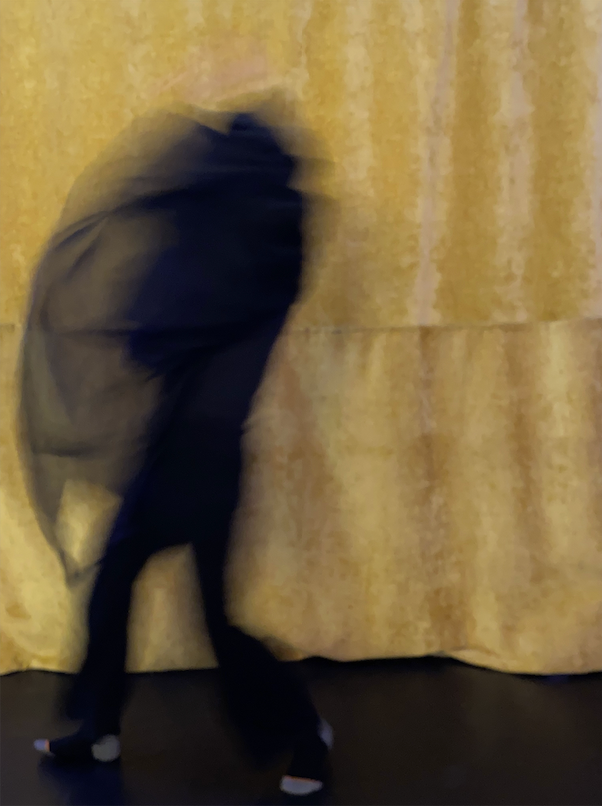
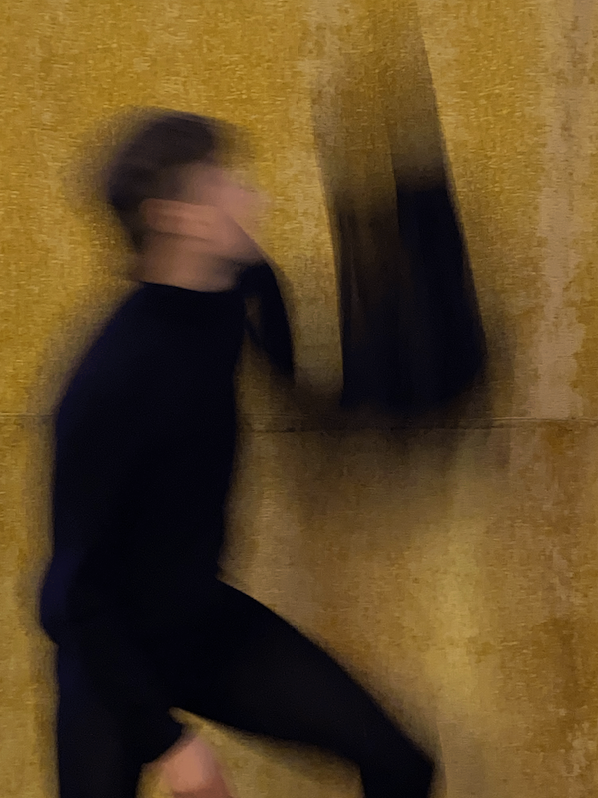
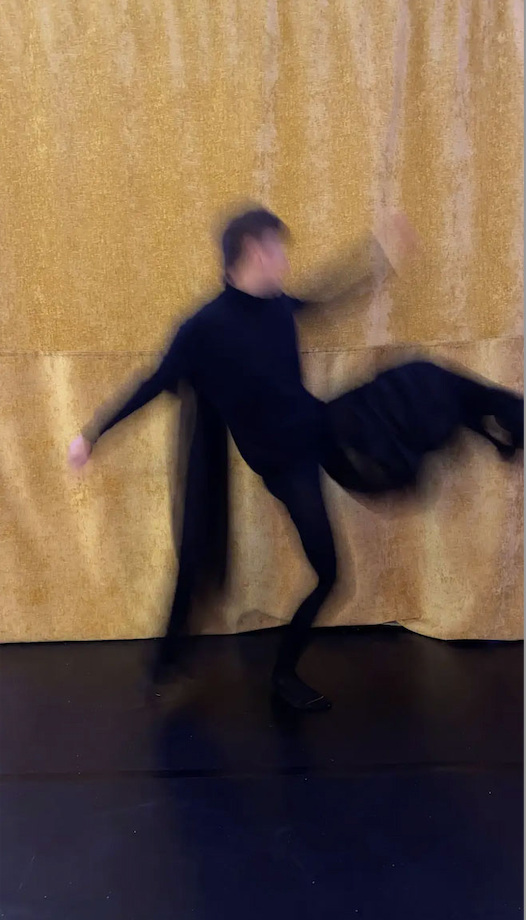
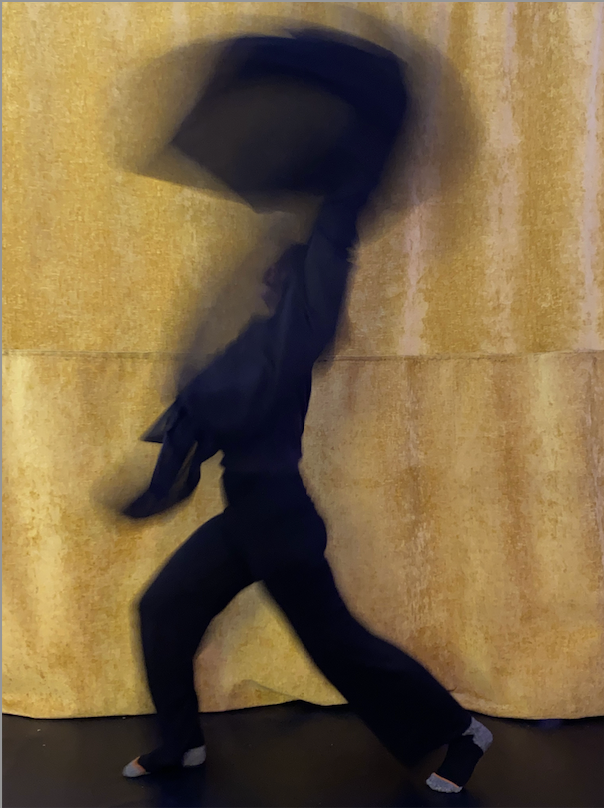
Description: Building on the movement practice, with the working system of three, we add a wearable element that enhances the felt sense of each point. We use a very simple element of a long piece of black fabric and safety pins. (We wear simple, all-black outfits as a base layer, to blend with the fabric). By balling, wrapping, and pinning this fabric into place on one of the points, two things happen. First, volume and weight are added to that part of the body, giving it a heightened sense of presence and altering its movement. Second, it changes the silhouette of the body as a whole, so that to an external eye, the subject becomes more ‘creature.’

Directions: Start with point A (or whichever you please). Take a length (2-3 meters) of black fabric, and bunch it up / wrap it / pleat it / play with it around the chosen point. Allow the mood of the point to dictate the form; maybe it is tight and dense, maybe loose with a long train. Pin the fabric into place with safety pins. Begin to move, slowly at first, and test out how the added mass alters the movement of the point. Working with a mirror or a camera, observe how moving the point with mass changes locomotion. Observe how your silhouette may start to look less human. What do you see when your silhouette is warped by the massiveness of a dominant point? Working with an iPhone camera, we start to see not-quite-human forms in the blurred, low-res shots of ourselves. Repeat this exercise with each point, and see how your edges transcend themselves differently with every new arrangement. Note: wear a base layer that you don’t mind possibly tearing small holes in, as the movement, when rambunctious, may tear the garments.

Experiment 3.1: Movement for knee
Experiment 3.2: Movement for wrist
Experiment 3.3: Movement for clavicle
Experiment 3.4: Movement for hand
1 / 0

Experiment 3.1: Movement for knee

Experiment 5: Moving into the Multi-body body?

Provocation: What happens when three body-ody-odies practice chimerization together? Moving through a tuning process together, may three individuals become the three points in a conglomerate chimera? This process is akin to morphing from an organism into an organ in a larger organism. Incorporate costuming to connect the bodies. How do you move? How do you coordinate, cooperate, and communicate?

In Zurich in the summer of 2025, at the School of Commons cohort meet-up, we tested this experience with our peers in a workshop, Stretching Into Chimera, in collaboration with Ula Liagaite. We invited a group of 18 to move with complementarities in their bodies, and then to move as one, cooperative body. The memory— confirmed by a poorly cropped iphone video—is of a flailing mob of newly-made friends, and by the end we were all laughing.

3. Integrating the Monster

“Not simply tolerating difference, but actually understanding that reality is constituted not only by many worlds, but by many kinds of worlds, many ontologies, many ways of being in the world, many ways of knowing reality, and experimenting with those many worlds.”

Amaya Querejazu6, 2016

Tangling

As ecological artists, chimerizing is one of many possible paths to relating to the more-than-human. In the wake of increasing warfare and a dismal recent COP30 conference, the climate crisis is inevitable. It’s happening right now, in fires and hurricanes and mass extinctions, with more looming catastrophes that will hit those with the least amount of power the hardest. We, along with the rest of the global ecosystem, are in danger, and we’re all tangled in it together. While we, as humans, have a handful of apathetic billionaires deciding this fate for the rest of us, we still have a duty to protect our planetary neighbors who had no say in it, and who cannot verbalize their needs in the same languages we speak. This task is beyond daunting, but to ‘check out’ is an all-too convenient response – and it isn’t an option.

We are interested instead in toolkits that allow us to ‘stay with the trouble.7’ While Harraway’s framework is cited broadly and liberally in circles close to ours, we must return to it again and again. Her words on interspecies entanglement and response-ability—our agency as human neighbors—provides us some clear direction, a call to action. There is no limit to the methods we can and should explore to root ourselves in an ecological pluriverse.

We also came across the term panpsychism in the writings of Rebecca Tamás8—a word for the ubiquitous presence of consciousness. Everything—both organic and inorganic—has an expression of thought. While the science behind the concept is a bit fringe, lying in the realm of post-materialist quantum physics, the poetry of it is ancient and palpable. But if we push a step further and blur the lines of ourselves as conscious units (a common theme in our research, also adopted from quantum physics), we wonder: does ‘thought’ bleed across the dissolving barrier of I:We? If everything is thinking, including each insect, stone, and body of water in our planet’s doomed habitats, and chimerizing into our environment allow us to think with these other bodies? When we are all the same global body, wouldn’t we think and feel as one?

After we filter theory through somatic practice, we remain open and aware of how our exercises might bloom in daily life. Learning is never complete until it’s integrated into our larger fabric of thought and behavior, and so our next step is to carry the lesson home from the studio.

A body is the hinge between inner and outer worlds. Our somatic knowledges of chimerizing, of monstering, and of queering, refract through our body’s senses, expanding subjectivity into a spectrum of external possibilities. The knowledge of one’s own multiplicity—as felt-sense, on the deepest physical level—is a knowledge that mirrors truths of a multiplicitous world. The Chimera-as-monster changes from feared ‘other’ to protagonist… and this is a critical entry point to growing empathy for non-human.

(1)
(3)

Le Guin, Ursula K., and Bul Lee. The Carrier Bag Theory of Fiction. Revised single edition. [Gardena, California?]: Cosmogenesis, 2024.

(4)

“Equating Respect for Trans People With Terrorism Is as Dangerous as It Is Absurd | Outright International.” Accessed November 28, 2025. https://outrightinternational.org/insights/equating-respect-trans-people-terrorism-dangerous-it-absurd.

(5)

Know Your Meme. “A Secret Third Thing,” September 1, 2022. https://knowyourmeme.com/memes/a-secret-third-thing.

(6)

Querejazu, Amaya. “Encountering the Pluriverse: Looking for Alternatives in Other Worlds.” Revista Brasileira de Política Internacional 59 (November 16, 2016): e007. https://doi.org/10.1590/0034-7329201600207.

(7)

Haraway, Donna J. Staying with the Trouble: Making Kin in the Chthulucene. Duke University Press, 2016. https://doi.org/10.1215/9780822373780.

(8)

Tamás, Rebecca. Strangers: Essays on the Human and Nonhuman. London: Makina Books, 2022

Lou Croff Blake

Lou (they/them) is a transdisciplinary artist, writer, and educator. They collaborate with Madelyn Byrd as the creative duo Chimera.

Madelyn Byrd

Madelyn (they/them, b. 1992, USA) is a musician, interdisciplinary artist, and educator investigating connection, home, biophilia, and the adjascent possible. They collaborate with Lou Croff Blake as the creative duo Chimera.